Zipper Podcast Episode 9: How Client Connections Grew a Business
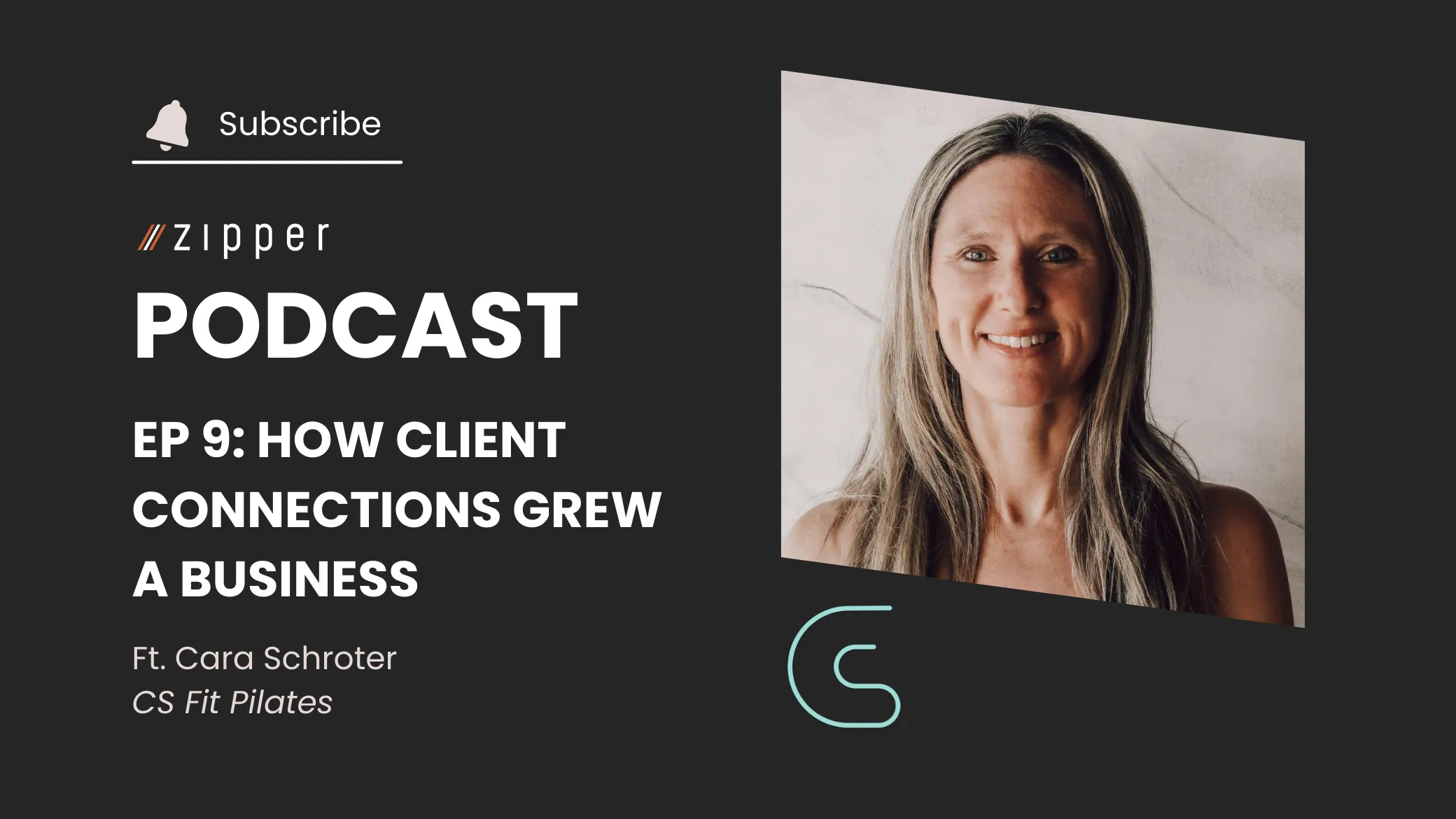
Cara Schroter, founder of CS Fit Pilates, shares how community-focused practices grew her into three Pilates studios across northern New Jersey.
Summary
Cara Schroter, founder of CS Fit Pilates, shares her journey of opening three Pilates studios in New Jersey. She started teaching on Zoom during the COVID-19 pandemic to keep her clients active and connected. She opened her first studio in a small space with minimal equipment and gradually expanded as the demand grew. Cara emphasizes the importance of community and personalized experiences in her studios, offering small, intimate classes with a maximum of six participants. She also values kindness and building relationships with her clients. Cara’s studios focus on classical Pilates and she partners with Peak Pilates for instructor training.
Takeaways
- During the COVID-19 pandemic, Cara Schroter started teaching Pilates on Zoom to keep her clients active and connected.
- She opened her first studio in a small space with minimal equipment and gradually expanded as the demand grew.
- Cara emphasizes the importance of community and personalized experiences in her studios, offering small, intimate classes with a maximum of six participants.
- She values kindness and building relationships with her clients, and reaches out to those on waitlists to offer alternative options.
- Cara’s studios focus on classical Pilates and she partners with Peak Pilates for instructor training.
Our Favorite Quotes (Cara’s advice!)
“I think the best advice is just, you’re going to have to hit the pavement and run hard…Like there’s a fitness place on every corner. So it’s like, if you’re going to do this, you’re going to have to do it.”
“If there’s a wait list and there’s people on the waitlist, it bothers me to no end. So I’ll actually reach out to everyone on the wait list. Every single time there’s a wait list, I reach out to them with plan B’s like, Hey, if you don’t get in, how do you feel about this? Or, Hey, if you don’t get in, you know, do you want to jump to this? Like I always try to give options and I just want them to know like, Hey, I see you. I know you’re there. I’m really trying to work this out for you.”
Transcript
Chris Alto (00:01): How’s it going? This is Chris with the Zipper Podcast and today we have Cara Schroter who is the founder of the CS Fit Pilates, which is a three location Pilates studio out of New Jersey. Cara, thanks so much for coming on and sharing your story.
Cara Schroter (00:14): Thanks for having me, Chris. I’m excited to be [here].
Chris Alto (00:17): Amazing. So I don’t want to ruin anything. So I’m just going to kick it off to you. I’d love to just hear a bit about your background. I believe you opened up your studios during COVID or right after COVID. So cool story there, going from teaching, I think, like Lifetime or something to becoming an entrepreneur. And things seem to be going very well. So I hand it off to you. I’d just love to just hear your story. And I’m sure I’ll have some questions to ask as you’re telling [it].
Cara Schroter (00:34): Yeah. Okay. Yeah. So it started during COVID. I was at Lifetime — things shut down, you know, they told us two weeks shut down. I was one of those people that actually thought it was going to be two weeks. So I had a bunch of clients that I trained daily between personal training and Pilates. And I was like, these people are going to lose two weeks of time. I have to keep this going. Like I don’t want them to come back to the gym and be deconditioned.
The next day we started on Zoom and I just kept going — like five days a week, and then it turned to six and seven, and I had like a packed Zoom schedule. So I was kind of working during COVID, but not as the goal to start a business — literally just like, this is the bridge from now to when the gym opens up. It was never the plan to be like, “I’m going to open up a studio.” It was like, I just need to keep these people going. It really was the motivation for me — my clients and to kind of just stay connected with them and to keep them healthy during a time like this. So that’s kind of how it started.
And then I finally got one small studio space a year later. It was March of 2021 — the smallest studio space in the middle of an industrial park. The rent was $600 a month because I was like, okay, I can make this in like two days and get some revenue out of [it]. So it was like a very small starting point. I bought a reformer off of Marketplace. I bought two towers off of Marketplace, figuring I could do a duet session if I wanted to. And then that one reformer grew to five.
It’s still kind of like an in-between thing. Like I’m still like, “I’m going to go back to Lifetime now.” It still hasn’t clicked to me that this is happening. I’ve just been in the midst of building, building, building. You don’t take the moment to like sit back and be like, what just happened?
Chris Alto (02:48): So it was very, very serendipitous, I guess, to getting that first location opened. So tell me about that process of finding the first location. What were some things you looked for? Did you find a realtor? How did that work going from teaching on Zoom to finding that first location?
Cara Schroter (02:59): Mm-hmm. Yeah. So for me, I have two girls, two little girls, and they did gymnastics right in Mahwah. And for me, it was so important for my location to be by their gymnastics studio, because when they started going back in person, I was like, okay, I can kind of piggyback off — when I dropped them off, I can go and work. The spot I got actually had like a small office room that I kind of set up for them. So if they had like Zoom school home that day, they were able to kind of work in the other room as I was teaching.
So that determined my location. I was like, I got to be by gymnastics, that’s it. And it just happened to be in the middle of my house and a lot of my clients were around that Montville, Northern New Jersey [area]. So it was kind of in between, which was great because it was like 12 minutes each way for both of us.
My aunt was a realtor, so that was an easy process. No one was really looking to get an office space during that time, because everyone was very much working from home. So I think that’s how we kind of landed on this. It was a great deal. I was like, that was the only way I was doing it. I wanted to go into it knowing it was going to be fine. I didn’t want to fail. And it was a very nerve wracking thing to even take on a monthly rent. So I just had to make sure it was a very low monthly rent.
Chris Alto (04:25): Sure. Wow, cool. And so you found the location and you started just off with — you got some equipment off of Facebook Marketplace. Did you hire anybody to like build the interior design of it or did you just kind of do it your own thing? How did that process [go]?
Cara Schroter (04:44): Well, I went to school for interior design.
Chris Alto (04:47): There you go. Finally.
Cara Schroter (04:50): I mean, I did. I worked in the city, I did the New York thing. But you know what? It was like, for me, it was so not about that. It was really just like, I knew I wanted good equipment. I wanted Peak Pilates equipment. So when I found that off of Marketplace, I just knew I needed a clean, open space. Like, again, super nerve wracking, did not want to put a dime extra into this. My job was just to go in there, use it as a studio — make sure it was safe and clean and all that good stuff for my clients. So as far as the build out and stuff like that, we just painted the walls. I threw down one of those Pergo floors on top of the rug and I called it a day.
Chris Alto (05:30): Nice, simple. Okay, cool. And so you had the one, and then when did you start to grow it out? At what point did you feel as though you were getting enough momentum to start adding more reformers, investing some more money into the space?
Cara Schroter (05:47): Yeah. So when we started, it was still very much like COVID spiked, COVID went down. It spiked, it went down. So I remember we had the five reformers and then it popped back up again. So I actually took the one reformer, pushed it against the wall, closed that one down, and then we had just the four. And I was very strategic about who I put in class together. Some people were super hyper of like, “My God, where have you been?” Where other people were like, “eh, it’s [whatever].”
So when I was busy, I’m like, but am I busy or is it just because I now have to have multiple classes to kind of accommodate the needs of all these people? Now I’m down to four reformers, but then what happens is you start having waitlists. You can’t get the people in, which totally drove my anxiety through the roof because I’m a people pleaser and I’m like, I can’t get these people in. So then you just start doing more and more classes.
And honestly, I really wasn’t even planning on opening up a second studio. It was actually my husband — we did our year of taxes and he saw what it did and he’s like, we need to duplicate this. And I was like, but you can’t duplicate me. So how are we duplicating this? It’s by no means a passive income type of thing. I need to be there in order for this to work.
So we kind of sat down, crunched the numbers, figured out, okay, we can do this, if this happens and this happens. I knew Nicole for a while, since 2014-ish. She’s the manager at Allendale. And I remember I said to my husband — his name is Nick — I was like, if Nicole says yes, I’m in. If she says no, I’m out. We’re going to just keep doing this and it’s just going to be a nice little side thing I got going on — which was totally full time, but in my head, I still told myself it was a side hustle and it was fine. I didn’t want to commit to the seriousness of it. And yeah, she said yes, and we did it.
It really was just the volume of people. And it was all word of mouth. I think it’s because we had this small studio space and people felt safe coming in there. I knew everyone coming in there. I knew their lifestyle. I knew where they went. I’m a very personable person with my people. I know you, I know your schedule when you come in. You’re not just like Joe from down the street. So I think people really appreciated [that].
Chris Alto (08:16): So it sounds like community has been really, really important. Do you do anything to harbor community? Do you do events outside of classes or anything to get people to build those relationships who might not know each other?
Cara Schroter (08:29): Yeah, I mean, we always keep talking like we need a field day outside with everyone. As far as community goes, now that we’re kind of established with the second location, we are giving back to the community. I have instructors now that are going through the teacher training process and we’re doing community classes. So we offer those classes completely free to our people. That way our new instructors can get involved, get their hours, and then we’re kind of giving back to the people that have been so awesome to us. But as far as like events outside with partying and drinking and all that stuff, no, we haven’t done anything like that yet.
Chris Alto (09:08): Not yet, soon enough. Amazing, cool. So that sounds really interesting. And I know that we talked a little bit about you teach instructors on how to be good instructors. What do you think separates good Pilates instructors from maybe average or not so great Pilates instructors? And if someone is maybe an instructor today or wants to get into it, what should they think about to become really, really good?
Cara Schroter (09:39): Yeah. Such a good question because I feel like now with Pilates being so popular — when I started, it wasn’t so popular. But now I feel like there’s so many ways that someone can go about it. The biggest thing I think that separates a great one from a not so great one — I’ve never experienced a not so great one because it’s terrible to say [that].
Personality for sure. I feel like you need to really connect with the person you’re teaching and who you’re teaching to. So you’re not just going in there and teaching a blanket class or a cookie cutter class. It’s like all-size-fits-all. I think you really need to go in there knowing, okay, these are the people that I’m teaching. This is what they all need. Go in there with some kind of theme so they know why they’re doing certain things. The more you can educate what they should be getting out of it, the more that they will get out of it. So I think that’s huge.
The other thing — and my younger self would hate this answer — but experience. I never valued that until I’ve been in this for so long. Just recently I did my advanced cert with Peak this past April — I literally just finished the full blown bridge with Peak. And just to go through that, I grew so much as an instructor now. I’ve been teaching since 2008. There’s so much room to grow.
So I think if you keep that mindset as an instructor — you’re not going to know everything. Sally down the street is going to have a different technique. As you find what makes you great and different, stick to it and don’t change to try to mimic anyone else. You’re going to get that all the time. Someone’s going to come in and be like, “I went to so-and-so and they do it this way.” You could so easily be swayed in all these different directions. But I think if you find why you started here and what you love most and why you’re doing it and you stick with that, no one can take that away from you and that’s really what separates you from anyone [else].
Chris Alto (11:35): So it sounds like you had tons of experience before actually going out on your own. I’ve heard different answers on this — around just jump in head first and go open a studio, or you need to get some experience. If you go back, would you have jumped in head first or are you glad that you got those years of experience prior to starting your own business?
Cara Schroter (11:54): Okay, so Chris, I don’t think you know this, which is so funny — you just asked me this. I opened up my first studio like 2009 and it didn’t go well.
Chris Alto (12:04): Oh, okay. All right, didn’t know that.
Cara Schroter (12:08): Yeah. And I was certified in 2008, so I did not have a brand for myself. My name was not around. I had a lot to learn. Granted, it was more of a mat-based studio. I did MVE chair, which is like a Peak Pilates-style chair class. I had a ball with it. It was fun. It was great, but I didn’t know enough. My rent was too high. My experience was too low. I didn’t understand what it meant to run a business.
There were so many things that I learned from that. But to be totally honest, I’m not saying don’t do it if you have the will to do it, but at the same time, if you have a name for yourself and you have clients and you know that, hey, I have a really great foundation to start this with — you’re going to be pretty good. Compared to not having any clients and just throwing things at the wall, see what sticks. It’s a lot. I was living at home, thankfully. I was around 25 years old when I did it. Looking back on it, my brother-in-law and I used to joke around — you should start a program where you go town to town and coach people on why not to open a business.
Chris Alto (13:22): There you go. Could be a business.
Cara Schroter (13:23): So that’s why this whole thing was like, “Cara, what are you doing? You swore off ever doing this again.” But that’s why I tiptoed into it. I kind of knew the difference and how to handle this. At Lifetime, I ran that Pilates studio and they really coached you on how to run it — what the dollar amount on every reformer is, how not to leave money on the table. You really have to be a business minded person to run [a studio]. As much as it sounds cute and cool to run a Pilates studio, there’s so much more than that.
Chris Alto (14:00): What is the biggest mistake you made when you opened that studio in 2009?
Cara Schroter (14:05): The rent was ridiculous. So high, so high, so high. It was ridiculous. I think I did also do an unlimited membership, which I like to call the kiss of death in Pilates. You can’t project your business. It’s absolutely impossible.
Chris Alto (14:07): Just too much cost. No, okay, all [right].
Cara Schroter (14:28): You don’t know if someone has an unlimited — if they’re coming in one day a week, two times a week. They say on average, it’s like three times a week and you come out on top, but you don’t know that. I know some studios that offer that and people are there seven days a week. That’s a loss. You’re not making any money off of that. Still now I get people, “Can you do an unlimited membership?” I’m like, no, unless I’m going to give my landlord the notice the same day that I’m closing. I won’t do it.
Chris Alto (14:53): Interesting, okay.
Cara Schroter (14:54): Yeah, it’s a totally different business model. I only take six people in at max. So if you have 20 spots to fill, you could do an unlimited membership. You have 20 people coming in and then you can kind of do the math a little better. But when you only have six reformers, how are you supposed to figure out — in order to pay your instructor in a good way and still come out on top with revenue — it’s literally impossible to figure that out.
Chris Alto (15:21): Okay, really interesting. So you only do class passes or packs?
Cara Schroter (15:26): We do monthly memberships, but we do — if you’re coming once a week, twice a week, three times a week. It’s based on that. And then I do a 10 class pack that lasts for three months, and I do drop-ins. So we try to keep it as simple as possible. And we don’t do sales. I never do sales because I created these prices for [a reason] — there’s a reason why behind it. And if I’m paying my instructors at a certain [rate], because I have great instructors, and if you’re going to value those great instructors, there’s a certain base rate you have to start them at. It’s all because of that. So I will never do a sale. I think it devalues the talent.
Chris Alto (16:14): Interesting. And so I know something that’s pretty cool that you do as well is you stick to small six person classes. How come you haven’t opened that up to be larger? Is there a specific reason that you keep it to six clients?
Cara Schroter (16:15): Yeah. It is hard enough to find six people that all move the same, all have the same issues, that don’t have the same issues, that have the same experience in Pilates. There’s so many different scenarios that you get. With our small group, we can micromanage. I like to really know everyone. I have notes on every single client that walks in that door. I know if they have a herniation, if they were a dancer, if [they] play pickleball, if they had a shoulder issue — it’s all in there. So when I go to teach, and any of my instructors that teach, we go through every client in that class.
We like to try to keep the same clients together in every class so we can progress them. And then on top of it, it really forms this camaraderie with the group. You get a text message if you don’t show up — “hey, why weren’t you there?” Not for me, from someone in your class that’s used to seeing you. So it forms this really great community and accountability when you’re with the same people.
That’s why I really will only do six because it’s really hard to find six people that move exactly the same. If I’m giving them a classical experience — the order that Joseph Pilates did — I want to try to progress these people and give them that. On top of it, when you start doing these other exercises in level two, level three, you need spots. I can’t spot 12 people, and I want to be able to spot the people that are in front of me. So it’s really just to get a better experience.
Chris Alto (17:59): Cool. So it’s like allowing the personalization of six is kind of the cap to be able to do [that].
Cara Schroter (17:59): Yes, totally. And six is even a lot. I’ll have moments in class where I’m like, okay, guys, we’re going to break this down. I’ll break it down and joke with them. I’m like, I need to spot, you’re going to kind of hang with me here. But they appreciate it. And then they get to do all this really awesome stuff that, if you were in a room with 12, 15, 16 reformers, you can’t do that stuff. It’s not a knock on any of those businesses. You just literally can’t do it. Someone will get hurt.
Chris Alto (18:37): Cool, very cool. Now you’re opening your third location. Can you tell me a little about that process and how you’re going from two to three and any pieces of advice you might have for other folks who are expanding?
Cara Schroter (18:49): Yeah. So it’s kind of the same scenario again. When I went from one to two, I knew I had a certain amount of people that I needed to house. So that’s why we did the second location in that location. We added a couple more instructors — instructors I’ve known for a while. I know the instructors very well.
And then it’s kind of the same thing that’s happening again. So we’re growing. Now I know I have a certain group of people in a certain location and I already know they’re going to Hohokus. So the classes that have been wait listed in Wyckoff, I can now bring more people in. Or in Allendale, I can now bring more people in, and that way that one location, Bridgewood people will go to Hohokus. So it’s kind of the same thing. As long as you kind of know like, okay, I have these people to kick that off and I can start that there, and I can open this up for XYZ to come in here, it just makes sense.
The formula that I have is so simple. It’s not fancy. Don’t reinvent the wheel. It’s very simple. And it’s just that moment of like, okay, we could do one more. This one, honestly, would have — three? Like, my God, three. My husband was like, no, it’s the third one. It completes this triangle of this radius that he figured out. And it really does. We’re in Bergen County. All three studios are in Bergen County. So people ask me that too — they’re all eight minutes apart almost. But if you take the radius of the outside circle, it hits a lot of Bergen County. And we’re a small [studio] — like you said, six reformers. There’s not a lot of those studios around.
I’m already getting emails from old clients from back when I was at Lifetime and they’re like, “My God, I saw you’re coming to Hohokus.” So I’m already getting people in there without even officially being open. But it’s just knowing that you’re at a certain threshold, you need more reformers. I’ll never put more than six in a spot. I’m very passionate about that piece. So the only way to grow more is to get another space.
And again, reasonable rent is huge. My studios are small — they’re 800 to 900 square feet. They’re not big, and that includes the storage room and the bathroom. The rent is small. And then I put the six reformers in. So it’s just this formula that has been working for me.
Chris Alto (21:33): So rinse and repeat. You have the formula. Now you just rinse and repeat it. Cool. When’s number four coming? We’re all waiting for it.
Cara Schroter (21:37): Yeah, now I’m done though. I’m not doing anymore. No, no.
Chris Alto (21:37): Very cool. Then about — obviously you have to have other instructors who you’re managing. What’s your process been for hiring and any learnings that you’ve had from hiring folks?
Cara Schroter (21:37): It’s so — the really cool thing, and I really didn’t even realize that I was [doing this]. Because of what’s going on with Pilates in this Pilates world right now, there’s so many versions of it. They’re all great in their own way. But I am definitely a Peak Pilates girl, full on through. I’ve done plenty of certifications. I’ve never gotten a better experience than I have with Peak Pilates. So I knew I really wanted to be a host studio for them.
So we have classical trainings at our studio. So now what’s happening is we have these instructors going through the certification. They’re using our studio for hours and for practice and all this stuff. And then we’re building relationships with these new instructors. And then they’re looking for a place to work. It really works. It gives me an opportunity to really get to know them, and it gives them an opportunity to get to know me without a working relationship. It’s more of just, “Hey, I’m going through this. Can you work with me on whatever it is?” And then I’ll help them and work with them. Just to see how they are — are they responsible? Are they going in and doing their hours? Are they showing up to classes? Are they getting good feedback? So it’s almost like a test run with these instructors. It kind of turned into this really cool, almost internship program without it being an internship.
Because we’ve been getting more instructors through this way of doing it, it just made sense. And the instructors that we have actually reached out and they’re looking for more. So we have the manpower to do this. I’m not looking for instructors anymore. The hiring is the hardest part. It’s finding a really good instructor. It really is so hard finding a good instructor. But I do think personality is humongous, and they have to mesh with who you are and the clients that come in there.
For me, my biggest thing is everyone is welcome. I want everyone to feel comfortable. There is no snootiness in my studio. Like, come in, you. We’re here to all have the same common interests of Pilates. That’s it. We’re not trying to be Instagram influencers. Hey, if we are, that’s great, but we’re not attempting to be those people. Someone said to me, “You need to post more videos of yourself doing this.” I don’t have time to do that. I teach all day long. So I think it’s huge to find someone that has common values [with you].
Chris Alto (24:25): That’s cool. You get a test run, you get to see who you like, who you jive with, and then [you have a] free feeder program for instructors for you.
Cara Schroter (24:28): Yeah. Yep. Totally. And you know they’re going through the best education in my opinion. It’s a great education. So it’s awesome.
Chris Alto (24:42): Is there any — so I heard a few things that you mentioned to kind of differentiate yourself in the area. You really focus on having intimate, personalized classes. You focus on really just building community. Is there anything else that you found to be helpful in terms of getting traction and continuing to grow the brand?
Cara Schroter (25:03): I — and this is such a simple thing — like just be kind, be nice. I’ve heard, and go figure, I’ve had clients come in and said, “I went to so-and-so and it was this, that, and the other thing.” I’m like, how? So I think it’s just like, just be kind. And here’s the thing — as an instructor, if you have things going on in your day, you have to leave it at the door. You’re there to almost like — you’re hosting a party. You’re there to host. You’re there for everyone to have a great experience. So just giving them the best experience and genuinely caring about them. If they come in there and someone looks a little off, I’ll say like, “Everything good? You all right today?” Just having relationships, I think it’s so [important]. At least that’s what I’ve heard — that’s been a thing that has really separated us.
And then the other thing that I do — I’m giving away a secret here, but I’ll tell you — is if there’s a wait list and there’s people on the wait list, it bothers me to no end. So I’ll actually reach out to everyone on the wait list. Every single time there’s a wait list, I reach out to them with plan B’s like, “Hey, if you don’t get in, how do you feel about this?” Or, “Hey, if you don’t get in, do you want to jump to this?” I always try to give options and I just want them to know like, hey, I see you. I know you’re there. I’m really trying to work this out for you. These are some of the things we can offer. So I think it’s just all those personalized touches that really make a difference, and it really makes people feel like they’re valued. I think that’s huge.
Chris Alto (26:40): Yeah, it makes a lot of sense. I can imagine if people are hearing from the owner saying, “Hey, how can I help you get into another class?” — that goes a really long way in building trust and makes them come [back].
Cara Schroter (26:42): Yeah. Because at the end of the day, I’m working for all these people. That’s how I look at it. You’ll hear, “Oh, you’re an owner. You must have the coolest hours.” I’m like, no, I have like 500 bosses. I have no freedom, but it’s my choice. I get that. I understand that. And like I said, it’s my own thing, but I’ll never let go of that. Because I know that’s why I’ve gotten so far — because that’s what I do. I like to have a pulse on the business and I like to know everyone that comes in that door.
It is getting to the point where I don’t know everyone. So I have to call Nicole and I’m like, “Hey, tell me about this person. Who is this person? I don’t know who this is.” I want to know everyone. I want to know who’s coming in there.
Chris Alto (27:33): Very cool. Okay, great. What did I miss? Any other piece of advice or learnings that you’ve had in your career in the fitness industry or becoming an entrepreneur and continuing to see your business grow?
Cara Schroter (27:46): Yeah. I think the best advice is just, you’re going to have to hit the pavement and run hard. Fitness is not — you can’t just do fitness. You can, but it’s a dime a dozen. There’s a fitness place on every corner. So if you’re going to do this, you’re going to have to do it. When I started, I was working seven days a week. I never said no. Someone wanted to come in at five in the morning? Sure. Someone wanted to come in at 8 PM at night? Sure. I just did it. And I kept telling myself, eventually there will be a light at the end of this tunnel. Now is not the time where there’s a light. And I feel still now I’m pushing this humongous snowball up a hill.
If you’re gonna do this in fitness, you have to be in the trenches with your people. You can’t be looking from the sidelines, like, “I’m only gonna teach five classes a week” or whatever. You could, but I don’t think you’re going to go very far. So you find what you love in this business and remember that’s why you’re doing it. That’s what’s going to be the motivation to keep you going. It’s a business you got to work at. It’s not a business you can just do a few hours here and there and hope for the best.
Chris Alto (29:04): Makes a ton of sense. It sounds like it’s all about the relationships for the CS Fit Pilaties.
Cara Schroter (29:07): Yes, totally.
Chris Alto (29:12): Cool. Where can folks find more information about you and about the studio?
Cara Schroter (29:17): Yeah. So we’re on Instagram — @thecsfit. We have our website, www.thecsfit.com. Any of those places. We do have a community tab. We do some virtual stuff here and there. You’ll see that if you’re not in the Jersey area. We offer first class free. We’re kind of on the social media platforms, but that’s about it. You will not see us really be doing any influencer type things. Maybe one day, maybe one day, we’ll get into that area of things.
Chris Alto (29:50): Sweet. Okay, so if you’re in Bergen County and you want to do some Pilates, check out the CS Fit. Sounds like it’s the spot to do it. So thanks so much for coming on, Cara. I appreciate it. And thanks for sharing your story. We’ll talk soon.
Cara Schroter (30:09): Thank you so much, Chris. I appreciate it. All right, bye.
Chris Alto (30:13): All right, see you later. Bye.
Run a Pilates studio? Zipper helps owners build community, manage waitlists, and grow with class management, a client booking app, and Pilates studio software built for boutique studios.