Zipper Podcast Episode 6: Lessons from 30 Years as a Fitness Entrepreneur
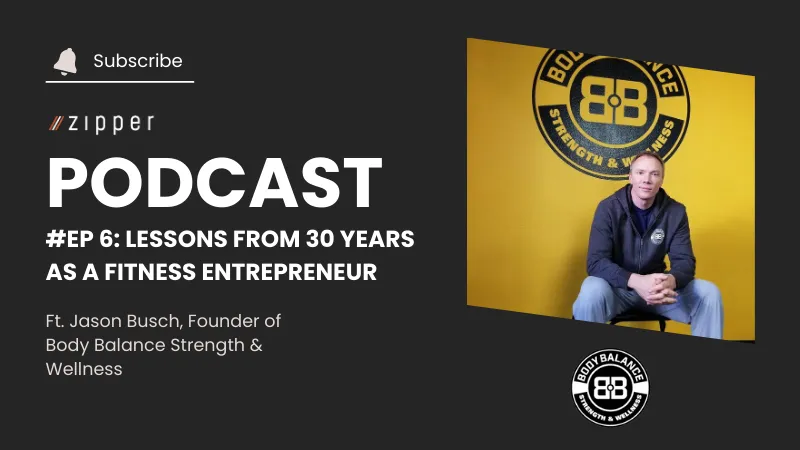
Jason Busch, owner of Body Balance Strength and Wellness in Boulder, CO, shares 30 years of fitness entrepreneurship lessons on partnerships, cash flow, and community.
Takeaways
- Body Balance is an integrated strength and wellness facility offering personal training, physical therapy, and myofascial release therapy.
- Movement assessments are essential for understanding clients’ needs and providing personalized recommendations.
- Gym ownership requires careful budgeting and a deep understanding of commercial leases.
- Financial risks and hard work are involved in gym ownership, but passion for the industry drives perseverance.
- Partnerships in small gym environments can be challenging and often fail.
- Strong contracts protect both the business and personal relationships.
- Manage cash flow carefully and keep overhead low to ensure financial stability.
- Treat people with respect and kindness, and create a positive environment.
- Align yourself with people who share your values, and don’t be afraid to make changes when expectations aren’t met.
- Perseverance and building strong relationships are key to long-term success in the fitness industry.
Transcript
Chris Alto (00:02): Hey there, this is Chris with the Zipper Podcast. Today we are lucky enough to have our guest, Jason Busch, who is the owner of Body Balance Strength and Wellness in Boulder. Jason, thanks for coming on. You’ve been in the industry for almost 30 years, so I’m sure you have a lot of nuggets for folks who are either currently fitness business owners or operators, as well as people who might be hoping to get into it.
Jason Busch (00:22): Thank you for having me.
Chris Alto (00:31): Tell us a bit about Body Balance, and then we’ll dive in.
Jason Busch (00:35): Body Balance is an integrated strength and wellness facility. We bring in athletes, weekend warriors, and the average individual who has a need or a want. We have career personal trainers working out of our space, physical therapists, and myofascial release therapists, plus myself.
We work with everybody from somebody who just wants to hire a personal trainer for one or two sessions to ongoing training. We sell memberships and teach fitness classes as well, just to keep it multifaceted and bring a new stream of people in.
We do a movement assessment with every client who comes in — the SFMA (Selective Functional Movement Analysis), part of the FMS education system. I wanted an assessment I could do on anybody in two minutes or less in street clothes that would tell me what I need to know. Based on the results, we make recommendations: if they’re struggling with mobility, we send them to the myofascial release therapist (my wife, Silvana). After that, they usually come see me for an in-depth movement analysis, and we do self-myofascial release work and movement drills — mostly T-spine, shoulders, hips, ankles. From there, I either work with them or send them to one of our other trainers, who all have a decade or more of experience. If they need PT, we refer them to our PTs, and the PTs refer people back to us.
We’re in a small space — about 3,600 square feet — and very machine-minimal. Mostly functional training: kettlebells, weights, cables, suspension training, medicine balls, and lots of floor space. It’s a really good version of Body Balance after multiple iterations over the years.
Chris Alto (04:35): Can you tell us about the founding of Body Balance and any tips for folks beginning their journey to gym ownership?
Jason Busch (04:52): (laughs) Don’t do it. I’m kidding. I’m 53 — a 30-year veteran of this industry in Boulder. My story is pretty traditional. I’m 6’6”. I grew up in Boulder, graduated from high school here, and moved to Michigan for a couple of years to live with my father before college.
Michigan is where I got my start as a gym rat. I was a skinny kid who didn’t like his physique. I worked out at a World Gym there, going from 150 pounds to 175, 185 — putting on muscle mass. When I moved back to Colorado for CU, I realized I loved the fitness aspect and decided I’d become a physical therapist. I switched my major into the sciences and got a B.S. in kinesiology.
I started working as a personal trainer in 1995 in Boulder. I loved the gym environment — locker rooms, cardio area, aerobics, strength training. By the time I was 27, I knew I wanted to own a gym. The average personal training rate in 1995 was just $30 a session, so it was hard to make a living as a full-time trainer. Most trainers worked just enough to support their lifestyle — they’re skiers, snowboarders, cyclists, runners, climbers. I figured opening a gym would give me different revenue sources and let me take that next step.
Opening the first gym
It was complicated. It was hard. It was painful. Owning a gym on a shoestring budget is a lot of work — long hours. I had a business partner — another personal trainer from the gym we worked at. Transitioning over wasn’t smooth. The owner of that gym was concerned about losing two of his busiest trainers, and as a young man I thought he was being unfair. As an older man, I understand why.
We sputtered along for a couple of years, broke even, and were able to hire an employee or two. It was very much a community gym — about 4,000–4,500 square feet, low overhead. Then life happened. Partnerships disintegrated and landlords did things that didn’t jive with me as a business owner. An opportunity came up to buy the gym I’d previously worked at. So I broke the lease, bought out my business partner, and bought that gym, combining the two facilities under one roof.
Chris Alto (14:00): How did you finance that?
Jason Busch (14:06): Owner carry. The guy I bought the gym from carried the note, so he got the interest. We way overpaid for that business, but I was young — I saw an opportunity to escape a complicated business partnership and consolidate.
Break-even is the curse of a business. When you’re break-even, you’re either reinvesting your trainer income to keep the business afloat — which means personally you’re struggling with mortgages and car payments — or you’re hemorrhaging money. You can only hemorrhage for so long before you close the doors. Two break-even businesses seemed better than one, but it was still very demanding. Perseverance — putting one foot in front of the other, showing up every day, finding solace in the weights — kept me going through lawsuits and complicated situations.
Commercial lease complications
We combined the businesses but soon faced serious problems. The landlord planned construction above our space — roof penetrations, floor penetrations, columns everywhere. We claimed constructive eviction and sued. I made some questionable decisions; the landlord sued back. The only real winners were the attorneys.
A client of mine — bless her heart — secured a bank loan for me after I laid out the financials. She became my guardian angel. Between what we borrowed to open the gym in the first place, what it cost to buy the second gym, the consolidation expenses, and what I had to pay my previous landlord, I had about a million dollars in debt.
Hidden costs of commercial leases
Something critical to understand: commercial leases require a personal guarantee. If your business can’t pay rent, you’re personally liable, and your personal assets are at risk.
Commercial leases also include “triple net” provisions — tenants pay taxes, insurance, and maintenance. These get assessed annually and can increase unexpectedly. Your landlord might bill you an additional $10,000–$30,000 if they underestimated expenses. That $10,000 monthly rent can suddenly become $10,500 or more. Something like 50% — probably 70–80% — of gyms fail. Understanding these hidden costs is crucial.
Avoiding failure
What helped me survive? Doing your homework. Being a serious fitness enthusiast is great, but business fundamentals matter. Manage your cash flow. Keep overhead low — crucially low. If you have skinny months, low overhead keeps you afloat. Going big immediately is risky unless you’re substantially financed.
The partnership disaster
Years later, an opportunity came to move into a newly constructed building in downtown Boulder, right across the street from our existing location — perfect for not losing clients. I negotiated with the ownership group. I needed a stronger personal guarantee, so I brought in a partner — someone I had purchased a gym from previously.
I was so focused on closing the deal I failed to ask for an NDA. I had everything prepared: lease, equipment list, finished specifications. He just needed to sign the lease and provide his financial statement. He did — and then booted me out within 12 hours. He had the personal guarantee; I had the business plan. The personal guarantee mattered more. I was completely out of gym ownership.
The darkest period
I’d been a gym owner since 1998 — almost 10 years — and suddenly I was just a personal trainer again. I questioned whether I could make it work. Around the same time, my former business partner had a mental breakdown over an unrelated lawsuit, eventually went to jail for a year, and ultimately died by suicide. I was managing the gym, fighting a commercial lease lawsuit, and navigating that tragedy all at once.
My only real asset was a Boulder condo my father and stepmother had purchased for me during college. As that property appreciated, I refinanced it and paid off the bank loan. I tackled the credit card debt I’d accumulated trying to keep the gym alive.
A snowmobile accident broke several ribs, lacerated my liver, and partially collapsed my lung — adding medical debt. As a self-employed person, I didn’t have adequate health insurance for a catastrophic injury.
After recovering, I worked as a personal trainer at various facilities for five or six years. I met my wife, who needed citizenship sponsorship, so I needed to meet minimum financial requirements. A client referred me to an operations director position at a Denver fitness franchise startup. I worked there about 18 months, earning enough to sponsor my wife’s green card.
I quickly realized I’m unemployable. I can’t take direction from others — I can’t accept someone telling me what, when, and how to do things. When that startup closed during the recession, I returned to personal training and rebuilt through word-of-mouth referrals: contacting previous clients, introducing myself in the community, asking chiropractors, physical therapists, and doctors for referrals.
Opening Body Balance
I genuinely wanted to own a gym again. In 2009, I opened at 28th and Iris in Boulder, starting in a tiny 1,250-square-foot space with very low overhead.
Keep your overhead low. Low overhead. Low overhead. If overhead is minimal, skinny months are manageable. Going big right away is hard unless you’re significantly backed.
We expanded gradually, taking three adjacent 1,250-square-foot spaces. We became a 24-hour access facility with no employees except my wife and me. We taught classes, opened memberships — we were one of about five Boulder facilities doing it then (now everyone does). We were thriving — converting it into a boutique facility with personal trainers contributing rent.
Then COVID-19 hit. For the first time in 30 years, somebody showed up and closed us completely. Membership revenue continued briefly, but when services stopped, revenue stopped immediately. I was seeing 35–50 sessions a week. Moving to Zoom maintained my income, but landlords still wanted full payment. We negotiated deferrals and eventually reopened, but maintaining that high-dollar retail lease was impossible.
An office condo became available for sale. We’d saved during the good years, so we bought it. We broke the lease, moved to our own facility, and started fresh — but this time as an owner, not a leaseholder. Everything is more controllable.
Chris Alto (40:27): Wow.
Jason Busch (40:28): Now I run a solid, reputable business with strong community referrals — including from Zipper. Everyone here has 10+ years of experience; some have been with me 10 years. Perseverance and daily improvement made this possible. I still work hard with long hours, but I get to work in a gym, pay my mortgage, and support my family. Getting here was hell.
Advice for new gym owners
Chris Alto (41:36): For someone in their mid-20s or early 30s starting their first gym, what’s your number one piece of advice?
Jason Busch (41:52): Manage your cash flow. Make good decisions. Don’t overcommit. Treat people with respect and kindness. Create an environment people want to spend time in. Foster cohesion without forcing overcommitment.
I’ve spent hundreds of thousands on advertising with minimal real returns — mostly brand awareness. Create a fun environment, do excellent work, don’t take yourself too seriously, and be empathetic. Understand clients face injuries, family commitments, professional demands, and personal challenges.
If you provide good service and treat people kindly and fairly, you’ll do fine long-term. Social media expertise helps, but in-person connection is irreplaceable. Teaching classes and building personal relationships in your facility creates loyalty social media can’t match.
Gym ownership remains solid. People will never stop going to gyms, seeing trainers, or taking classes. AI won’t replace this.
Hiring contractors and consultants
Align yourself with people who share your value system, similar goals, and vision — not just the first person available. When bringing practitioners into your facility, remember it’s your space. If you see something misaligned with your values and expectations, don’t hesitate to discuss it. Always remember: it’s your facility — you decide what you accept.
We started with chiropractors and switched to physical therapists — our experience has been better. PTs and fitness align naturally. We’re looking to add a chiropractor we genuinely like — someone who shares our expectations.
Don’t hesitate to make changes if reality differs from initial expectations.
Building long-term success
Smile, make people laugh, have fun, avoid taking yourself too seriously, and be empathetic. Gym owners experience similar challenges — clients leaving, summer vacations reducing attendance. For long-term commitment, avoid stressing these fluctuations. Focus on end goals.
You can make a good living in this industry with moderate stress and build wonderful relationships. At 30, you might focus on financial targets, but recognize that relationships ultimately drive success more than bank account balances. The people you work with become lifelong friends. Those relationships matter more than financial metrics.